
Steuben County Criminal Court Records
A criminal court record in Steuben County begins after a criminal case is opened in the county trial courts. The file can include the charging information, probable-cause material where public, bond orders, attorney appearances, hearing notices, motions, court orders, plea papers, sentencing entries, probation terms, fines, court costs, restitution, and the final disposition. The Steuben County Clerk criminal records page also says misdemeanor and felony costs, fines, probation fees, and restitution are paid through the Clerk's Office.
The same local source notes that the Clerk's Office will not perform a broad criminal search for liability reasons. That detail matters. A person who needs to search Steuben County criminal court records should use Indiana Courts Case Search, commonly called MyCase, then contact the Clerk for a specific file, copy, payment, or non-online document. The Clerk of the Circuit Court keeps records for both Steuben Circuit Court and Steuben Superior Court at the current Judicial Center.
The county criminal-record source is the first official place to check for local payment and record limits: the Clerk's criminal records page describes criminal payments and the search warning.
That local Clerk page is useful because it separates case payments and Clerk help from broad name-based criminal-history research, which must be handled through the public case search or a proper record request.
Steuben County Criminal Courts
Indiana is not a county-level district court state. Steuben County criminal cases are handled through Steuben Circuit Court and Steuben Superior Court, while the Clerk of the Circuit Court maintains filings and public records for both courts. The official court structure map for this county identifies the Clerk's Office on the first floor of the Steuben County Judicial Center, Circuit Court on the third floor, and Superior Court on the second floor.
For local routing, the Clerk of the Circuit Court maintains filings, payments, copies, and records at 305 South Martha Street in Angola and can be reached at 260-668-1000 ext. 2240. Steuben Circuit Court uses ext. 2000, Steuben Superior Court uses ext. 2600, and the Magistrate Office is listed at ext. 2300. Those office contacts help identify where a case is pending, but the Clerk remains the copy and record access point for the court file.
Criminal records should not be confused with jail custody records. A booking entry may show the arresting agency, jail intake data, a bond amount, or preliminary allegations. The criminal case file shows what was filed in court and what happened after the case began. For custody status, use the Steuben County inmate records page. For a closer look at filed charges after an arrest, use Steuben County arrest records and court charges.
Search Steuben County Criminal Records
The main public search path is MyCase, the statewide Indiana court case system linked from the Clerk's online services as the public user website. MyCase can show public, non-confidential case information and many public documents without a fee. The Indiana Judicial Branch MyCase help page warns that some documents are not online and older cases may not appear. If a document is missing from the online view, the Indiana court public-records page directs users back to the county clerk where the case is heard.
- Open MyCase and choose the public trial-court case search. Use the defendant's name, business name if relevant, or the full Indiana cause number from a notice or docket entry.
- Limit the search to Steuben County when the county filter is available. A statewide name search can return unrelated people and cases from other Indiana counties.
- Open the matching case and compare the court, case type, filing date, party names, and case status before relying on the result.
- Review the docket for filed charges, appearances, hearings, motions, plea entries, orders, disposition, sentence, payments, and probation or restitution entries where public.
- Contact the Steuben County Clerk for certified copies, older files, unavailable documents, payment questions, or a record that must be reviewed at the office.
Cause numbers are often the cleanest search key because they point to one specific file. Name searches need more care. Middle names, dates of birth where shown, filing dates, and court assignment help separate people with similar names. A result from MyCase is a public case index and docket view, not a full criminal-history background check for employment, housing, credit, licensing, or insurance decisions.
Steuben County Criminal Case Flow
A criminal case file changes as the case moves through court. The filed charge starts the court record, but later entries can change the meaning of that first accusation. A charge may be amended, dismissed, merged into another count, resolved by plea, tried to a verdict, or end without a conviction. The final disposition and sentence should be read with the entire docket, not from the first charge line alone.
Case flow: Charges Filed › Arraignment › Pretrial and Motions › Plea or Trial › Disposition › Sentencing
At the filed-charge stage, the court record begins under a cause number. At arraignment, the record may show the defendant's first plea or hearing settings. During the pretrial period, it may show attorney appearances, discovery issues, continuances, bond orders, motions, and judge rulings. At plea or trial, the file may show a plea agreement, verdict, dismissal, or other disposition. At sentencing, the record may show jail, prison, probation, community corrections, fines, costs, restitution, and other terms.
The Prosecuting Attorney is a key source for the front end of this process because that office initiates prosecution for criminal acts in Steuben County. The local prosecutor materials are tied to several criminal-case stages: charging, victim assistance, child-support enforcement when relevant, and coordination with law enforcement.
The prosecutor office source identifies the local staff list: the Prosecuting Attorney office divisions and staff page names the elected prosecutor and deputy prosecutors.
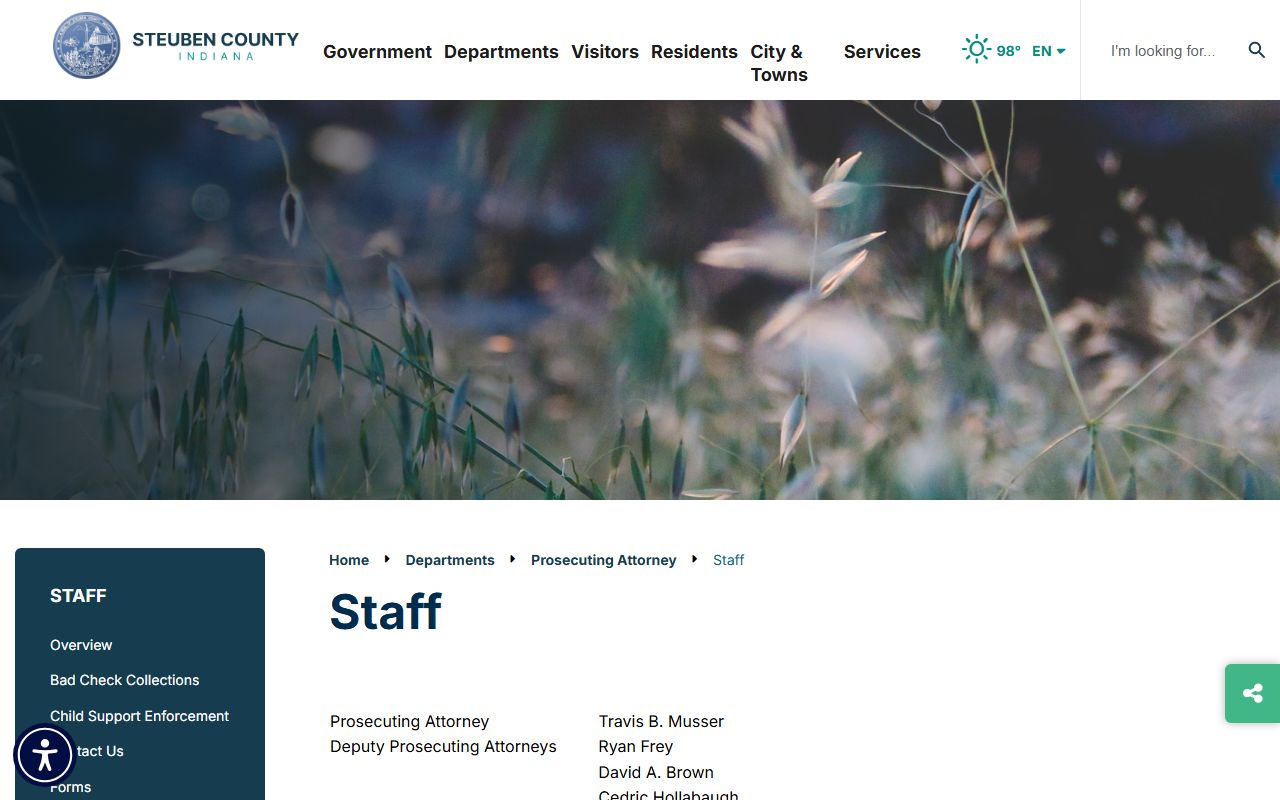
Those names help users confirm the official county prosecution source, but charging decisions and court outcomes must still be verified through the filed case record.
What Steuben Criminal Records Show
A criminal court record is a field-by-field history of the prosecution. The most useful entries are the cause number, court, case type, charge description, statute or citation, offense date when public, plea, disposition, sentence, and financial entries. Documents may be viewable online in many public cases, but the Indiana judiciary says some documents and older cases are unavailable online. A missing PDF is not proof that no record exists.
| Field | What It Shows |
|---|---|
| Cause number | The Indiana case identifier used for MyCase searches, Clerk copy requests, payments, and docket tracking. |
| Court | Steuben Circuit Court or Steuben Superior Court, plus the judicial officer where public. |
| Defendant and attorneys | The accused person, State of Indiana, defense counsel, prosecutor appearances, and party details that are public. |
| Charges | Charge description, statute or citation, severity level, filing date, and later amendments or dismissals. |
| Docket | The dated list of filings, hearings, motions, continuances, orders, warrants, pleas, judgment entries, and closure events. |
| Plea and disposition | The defendant's formal answer and the case outcome, such as guilty, dismissed, not guilty, or other final result. |
| Sentence and financials | Jail, prison, probation, community corrections, fines, costs, probation fees, restitution, and bond-related entries. |
| Restricted data | Redactions or exclusions for minors, sealed records, financial identifiers, confidential addresses, and other protected details. |
Short docket terms matter. A disposition is the outcome. A plea is the defendant's formal answer. A sentence is the punishment or court-ordered condition after conviction. Probation is supervision in the community. Restitution is money ordered to compensate a victim. If a case includes home detention, community service, or community corrections, the record may show court orders and compliance issues rather than program details.
Charges vs Convictions
Filed charges are allegations. Convictions are outcomes. A Steuben County criminal record may show a charge that was later dismissed, reduced, amended, or resolved through a plea to a different count. For that reason, a charge list should always be read with the disposition and sentence entries. A record that contains a public charge entry does not automatically mean the person was convicted of that charge.
| Point | Charge | Conviction |
|---|---|---|
| Meaning | A formal accusation filed or received by the court. | A final finding of guilt by plea, verdict, or judgment. |
| Record stage | Appears near the beginning of the criminal case file. | Appears after plea, trial, or court ruling. |
| Can change | May be amended, reduced, added, or dismissed. | Can be affected by appeal, post-conviction relief, or expungement if eligible. |
| How to verify | Check the charge status and related docket entries. | Check disposition, judgment, sentence, and later orders. |
Dispositions and Sentences
The final part of a criminal court record often matters more than the first charge list. Disposition entries may show that a count was dismissed, that a defendant pleaded guilty to a different offense, that the court entered judgment, or that the case closed without a conviction. Sentence entries can include jail time, probation, community corrections, home detention, fines, fees, costs, restitution, and no-contact or compliance terms.
Steuben County's official materials point to Community Corrections and Probation for supervision issues after sentencing. The Probation FAQ routes community service and home detention questions to Northeast Indiana Community Corrections, and noncompliance can create later docket entries or warrant risk. A person checking a case for current status should read entries after the sentencing date, not just the original judgment.
The local prosecution source explains who brings criminal cases for the State: the Steuben County Prosecuting Attorney overview describes the office's role in initiating prosecutions.

That office role explains why the charging document is not a jail record. It is part of the court case that later produces the plea, disposition, and sentence entries.
Sealed vs Expunged Records
Indiana law allows certain arrest, charge, juvenile allegation, and conviction records to be sealed or marked expunged when statutory requirements are met. The research for Steuben County points to non-conviction relief under Indiana Code section 35-38-9-1 and conviction expungement categories in later sections. The practical effect is public-access control, not physical destruction of every record. Courts and criminal justice agencies may still have access for official duties.
| Point | Sealed | Expunged |
|---|---|---|
| Public view | Removed from ordinary public access or hidden under a court order or rule. | Public-facing access is limited under the applicable expungement order. |
| Record existence | The record is generally retained but not open to the public. | Indiana research notes that expunged records are not physically destroyed. |
| Possible access | Court, clerk, or criminal justice access may remain for official purposes. | Courts and criminal justice agencies may retain official-duty access. |
| Eligibility path | Depends on the record type, confidentiality rule, and court order. | Depends on Indiana Code chapter 35-38-9, waiting periods, no pending charges, payment, restitution, and conviction limits where applicable. |
A Steuben County expungement petition is filed in the proper trial court depending on the arrest, charge, adjudication, or conviction category. The prosecutor may respond, and the judge decides whether the statute is met. If relief is granted, public MyCase access should not show the record in the same manner as an ordinary public criminal case.
Steuben Criminal Record Access
Indiana court records are governed by court-specific access rules as well as the broader public-records framework. The Indiana Rules on Access to Court Records set the court-record access system, and Access to Court Records Rule 5 identifies records excluded from public access. The Indiana Access to Public Records Act supplies the general public-records structure for Indiana agencies while recognizing records made confidential by law.
Access rule: Start with public MyCase information, then request unavailable documents from the Steuben County Clerk when a case is public but the document is not online.
The county prosecutor contact source is also useful when a question concerns the prosecution office rather than the Clerk: the Prosecuting Attorney contact page lists the local office address, phone, fax, and hours.

Use the prosecutor contact for prosecution-office business, not for certified court copies. Certified copies and court-file access remain Clerk functions.
Criminal Background Limits
Public criminal court records are useful for personal case review, court-date checks, copy requests, and understanding a case outcome. They are not a substitute for a legally compliant background check. Employment, tenant, credit, insurance, licensing, and other regulated uses have separate laws and screening duties. A MyCase docket can also omit sealed, juvenile, confidential, expunged, or older material.
Important: FCRA-regulated screening requires a compliant consumer-reporting source, not a public case lookup.
Restricted Steuben Criminal Records
Several criminal-adjacent records are not fully public. Juvenile records are confidential under Indiana Code section 31-39-1-2 except as allowed by juvenile-record statutes or court order. Adoption, mental-health, sealed, expunged, protected-address, financial-identifier, and minor-related material may be excluded or redacted. Active investigatory records may also be withheld by the agency that holds them.
If a public case appears incomplete, the reason may be a redacted document, a confidential filing, an older non-digitized case, or a record that must be requested directly from the Clerk. Public access should be verified through official court channels, especially when the record will be used to confirm a charge, disposition, sentence, warrant, payment status, or probation condition.